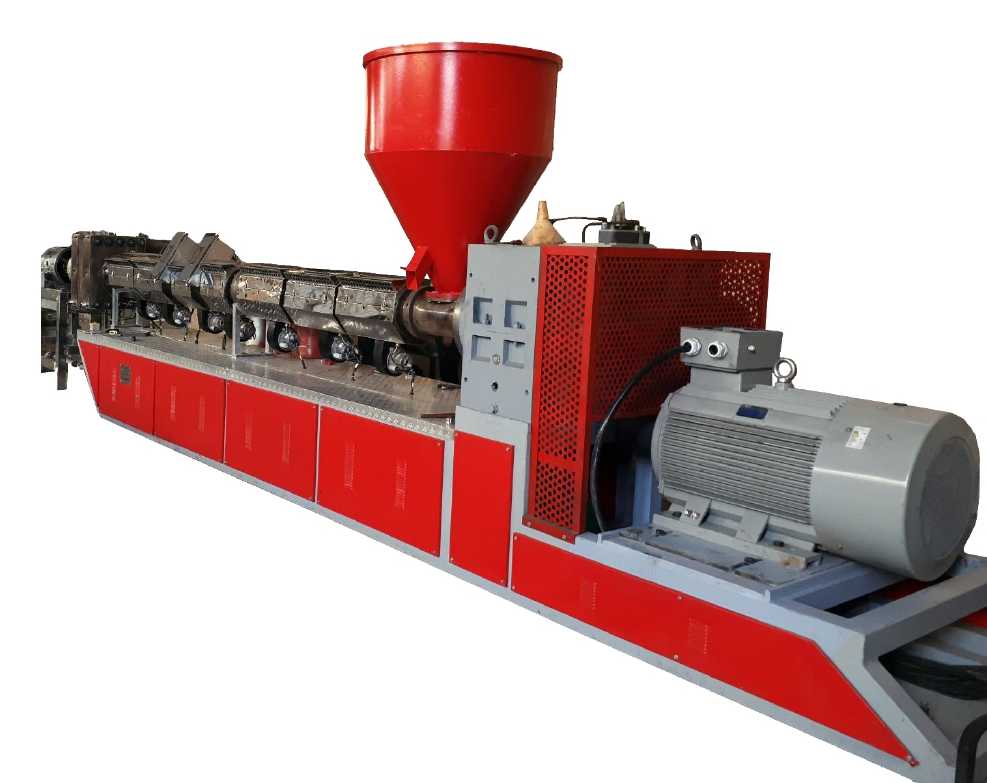
Extruder machines and their various types have a special application in the plastic recycling industry. Today, extruders can be considered one of the most powerful and successful machines in the plastic recycling industry through the extrusion method. The extruder is a simple device used to complete the extrusion process. Using a cylinder and screw system, the machine heats the product and shapes it through a mold to create the desired product.
Today, various types of plastic extruder machines with different functionalities are available in the market. However, to ensure that your company makes the best choice based on the type and quantity of produced materials, guidance will certainly be needed. For this purpose, in this article, we aim to introduce this machine and provide a more detailed review of the different types of extruders, their components, and various applications.
?What is an extruder machine

An extruder machine (also known as plastic extrusion) is an industrial device used to produce polymer products by melting and shaping raw materials. The operation of the extruder machine works by combining kinetic and thermal energy to send materials such as granules, pellets, powder, etc., into the machine. After mixing these materials with other additives, the machine initially produces a paste-like product, which is then transformed into the final product through various processes. In the following sections of this article, we will thoroughly examine how this process works.
Types of extruder machines
Extruder machines are produced in various types and are used according to the needs of industries. Below, we will review the different types of extruder machines:
(Co-rotating Twin-Screw)
This group of extruders is used in cases where we deal with more sensitive raw materials. The co-rotating screws in these machines increase the machine’s power, while the materials passing through the extruder are exposed to high temperatures for a shorter period.
(Counter-rotating Twin-Screw Extruder)
Another group of extruders has screws that rotate in opposite directions to each other and are primarily used to turn raw materials into a paste using the pressure created by the screws. These extruders are used for better and more efficient mixing of materials.
Single-screw extruder
Single-screw extruders consist of a rotating screw inside a cylinder and are used for shaping and melting polymer materials. After the polymers are melted, they pass through a specialized mold to take the desired shape.
Some of the most important advantages of single-screw extruders include:
High-volume production with a consistent output.
Efficient and continuous melting, mixing, and extrusion of materials.
Suitable for applications that require a continuous and uniform product.
Single-screw extruders are used in various industries, with some of the most important applications being:
Production of plastic granules (recycling and compounding)
Production of plastic films
Production of plastic fibers and fabrics
Production of molded products such as toys, containers, and automotive parts
Production of plastic pipes and profiles
twin screw extruder

These extruders consist of two screws placed in a single chamber and are used for shaping polymer materials. With this equipment, various materials can be mixed and shaped into the desired form.
This type of extruder has several advantages over single-screw extruders, including:
Better mixing
Higher production speed
Lower energy consumption
Twin-screw extruders are used in the polymer, chemical, and food industries for mixing various raw materials. Some of the most important products that use twin-screw extruders in their production process include:
Adhesives
Sealants
Soaps and detergents
Plastics
Chemicals
Food and edible products
Cellulose pastes
high speed extruder
A high-speed extruder is a type of single-screw extruder (and sometimes a twin-screw extruder) that operates with a much higher screw rotation speed than conventional extruders (up to over 800 rpm or more), providing high production rates, faster melting, and reduced residence time in polymer extrusion.
Disk Extruders
A disk extruder is a type of unconventional polymer processing device that uses rotating disks instead of screws for transporting, melting, and compressing molten polymer. In this machine, the movement of the material is based on viscous drag force or, in some designs, based on the elastic melt behavior response.
Ram Extruder
A Ram Extruder is a device in which the extrusion process is carried out through the application of direct force by a linear piston (Ram), rather than by a rotating screw. In this system, the raw material (powdered or paste polymer) is placed inside a heated cylinder and driven towards the mold (Die) by the reciprocating pressure of the piston.
This is a discontinuous (batch) process and is typically used for polymers that are sensitive to shear, such as PTFE (Teflon), or in precise applications like pharmaceuticals, ceramics, and rheological studies.
Applications of the extruder machine

As mentioned, the extruder machine is one of the most versatile pieces of equipment used in various industries. Below, we will introduce some of the most important applications of this machine:
Application of the extruder in the recycling industry
Recycling of plastic products is one of the most important industries where the extruder is used. To carry out the recycling process, plastic materials are first reduced to small sizes using a grinder or shredder, and these pieces are then fed into the extruder for the recycling process.
Application of the extruder in the plastic industry
Another common use of the extruder machine in industries is the production of various plastic products, such as plastic pipes, PVC films, and PP.
Other industries
In addition to the plastic and recycling industries, the extruder is also used in several other sectors. Some examples include:
In the food industry for producing products like puffs, snacks, pasta, and soy
Adhesive production
Animal and poultry feed production
Oil extraction from oilseeds
Components of the extruder
Each extruder machine consists of various components, and below, we will review some of the main components of the extruder:
Feed zone
This section of the extruder is designed to have an appropriate depth for receiving the required raw materials. Additionally, depending on the type of input materials, initial heat is also transferred to the materials in this section.
Compression and compaction zone
In this section of the extruder, the depth of the screw gradually decreases, and the raw materials become more compact and compressed. This compression helps to remove air from between the raw materials and also facilitates better heat transfer.
Measuring and metering zone
In this section of the extruder, the depth of the screw is fixed and smaller than that of the feed zone, and the molten material flows evenly with constant heat and pressure. Due to the fixed depth and dimensions of this section, measuring and metering the materials in the production process is also easily possible.
Filter
In extruder machines, a filter is used after the screw and before the die. These screening plates have holes of various sizes depending on the type of products being produced. The filters can separate any impurities present in the molten material. In addition to filters, breaker plates are also used in this section to prevent damage to the filters. Most extruder machines are designed with a mechanism that allows the filters to be replaced during operation, so there is no need to stop the production line while changing them.
Hopper
Another component commonly used in most extruder machines is the hopper. Due to gravitational force, polymer particles enter the extruder system through the hopper. These hoppers are typically shaped like standard funnels, as seen in other applications. Most extruder hoppers are attached to the machine using bolts and screws, and if replacement is needed for any reason, it can be done easily.
Heater
The heater is a part of the extruder machine that is installed around the cylinder and is responsible for transferring heat to the system. It is due to the heat produced by this section that the materials inside the cylinder melt and become ready for the next shaping stages.
Die Head
In all extruders, the final section is the material exit section, or the die. In pelletizing extruders, the molten material passes through the exit and is formed into strands, which are then cut by various methods to be transformed into pellets. The arrangement and size of the holes in different machines vary and depend on several factors, such as the material type, production capacity, and the type of cutting system.
Screw and cylinder
The cylinder and screw are other components of the extruder. The screws are metal, spiral-shaped parts and are considered the main components of any extruder. The primary function of the screw is to transform the raw materials into a paste-like consistency, and it is through the screw that the materials entering from the hopper are directed toward the machine’s chamber.
In most cases, the screws are designed in such a way that their speed can be adjusted according to the raw materials, production line conditions, and the type of output product. The length of this component ranges from 2 to 6 meters, depending on the desired product’s production rate and the type of polymer required. The most important characteristic of this component is the ratio of the screw’s operational length to its diameter. The diameter of the extruder screws typically ranges from 110 to 165 millimeters.
The other component of the extruder is the cylinder. The cylinder is the chamber in which the screw is housed. In addition to holding the screw, the cylinders are responsible for heat transfer, as well as controlling and stabilizing the temperature of the materials inside the extruder. The cylinders are the same length as the screws and, depending on the type of polymer, they may have a venting port or may not have one.
Introduction to the different modules of the extruder machine
A single-screw extruder consists of five main parts, which are: the drive system (motor), the feeding system (Feeder), the cylinder (barrel), the screen changer (die head), and the electrical and control system (including PLC and PID). In general, the components of the extruder can be described as follows:
Feeder

The feeder machine is responsible for providing a stable and suitable flow of material to the extruder. The feeder consists of a feeder screw. The screws in the feeder have technical specifications similar to those of the extruder machine’s screws, with the difference being that these screws do not have a compression or melting zone and only serve the role of material transport.
cover
The covers are designed and constructed according to the type and weight of the machine. For machines with medium weight, profiles are used, while for heavier machines, I-beams are utilized. The covers are made from 2mm sheets, and to cool the machine’s elements, these covers are equipped with a fan cooling system.
Motor and gearbox
The driving force of the extruder machine is provided by an electric motor. Depending on the type and power requirements, the motor may be directly coupled to the gearbox or connected via a belt. The gearbox is then directly connected to the machine’s screw. Depending on the needs, electric motors and gearboxes of varying power capacities are used.
Flanges
Flanges are the connecting components that link the parts of the cylinder, the cylinder to the hopper, and the cylinder to the gearbox.
Screen changer
To remove unwanted materials such as labels from the molten polymer flow, a screen changer, which is a filter controlled by hydraulic force, is used. The use of a hydraulic jack makes the process much easier compared to manual (sun) filters. The size of this component depends on the desired production capacity of the machine.
Cutter or cutting system (strand or water-
ring)
After the materials exit the machine, the strands are cut with a cutter and formed into granules. This section can be strand, water-ring, air, or underwater. The choice of the appropriate method for different materials results in different shapes of granules.
Electrical panel
Various equipment and devices in the electrical panel of each machine are responsible for powering the control and protection systems. Some of these devices include:
Heating element and fan
To heat the polymer inside the machine, heating elements are required. The elements are mounted in several rows on the extruder. Generally, the elements are ceramic and have the capability to generate high thermal flux.
Ammeter
Digital ammeters are responsible for displaying the current consumption in amperes. With these devices, the electricity consumption of high-power equipment, such as electric motors and heating elements, can be monitored.
Temperature sensors (Thermocouples)
Temperature control is one of the most important control elements in the extruder machine, and thermocouples are responsible for this task.
Inverter
The inverter is responsible for controlling the motor speed, which plays a crucial role in production quality. Fluctuations in this motor speed system manifest as fluctuations in production and a decline in product quality. Inverters, in addition to enabling motor speed control, also add protective and parameter-measuring functions to the system.
Phase control
Phase control is used to protect three-phase systems against the failure of one of the phases.
Load control
Load control is used to protect electrical components with high current draw.
Buttons and volume controls
Buttons and volume controls are used to control electrical circuits. The buttons are responsible for turning circuits on and off, while the volume controls generally handle motor speed control. In systems equipped with a PLC, most of these buttons are integrated into the HMI touchscreen display.
PLC
Depending on the customer’s order, the control system of the machine may be either analog or PLC-based. The role of the PLC in extruder machines is to implement the logic needed to control the machine, utilizing inputs such as temperatures and motor speeds from the operator. For extruder machines built by Matin Machinery, Fatek and Delta PLCs are commonly used.
HMI
These devices serve as the user interface in PLC-equipped systems. All device settings can be viewed and controlled through the HMI. At Matin Machinery, Fatek brand is currently used for this purpose.

How the extruder machine works and how to operate it
Generally, the operation of the extruder machine follows these steps:
Feeding the raw materials: At the beginning, raw materials such as pellets, powder, granules, or flakes are fed into the extruder’s feeding system.
Pre-processing: In this stage, processes like material transfer and preliminary preparation of the materials are carried out.
Melting and shaping the materials: During this stage, the raw materials are melted and then transferred to the material exit (Die).
Shaping: In the final stage, the shaped materials are cooled and form into their final shape.
Single-screw extruders are known as gas venting extruders, simple three-zone extruders, and two-stage extruders. When the raw materials are injected into the machine, they are subjected to pressure, heat, and mechanical and thermal stresses resulting from these factors, the magnitude of which is precisely calculated. The presence of these factors can cause a polymerization reaction that generates gas, or the gas in the polymer product may have been introduced from an external source.
To increase the service life of the cylinder and improve its wear resistance, an induction plating process is used in cylinder manufacturing. In the induction plating process, a magnetic coil is driven into the inner surface of the cylinder to harden it. As the coil moves, an inductive action is applied to the cylinder’s metal, resulting in localized heating and ultimately hardening the surface.
This process is also applied to the screw of the machine, which hardens the screw as well. The screw is placed in the cylinder with a specific geometry.
This specific geometry is designed according to the characteristics of different polymers, and these characteristics are usually unique. The screws of extruder machines are the heart and key component of polymer industries. Therefore, a proper understanding of the polymer’s behavior at each stage and designing the screw geometry to match those conditions is the most important factor in a correct and efficient screw design.
Due to the complex mechanical and chemical behavior of various polymers, the working conditions of the polymer can only be simulated using scientific and laboratory data. Then, using the information obtained, the extruder screw can be designed, and ultimately, by simulating the screw movement, the accuracy of the changes and designs can be ensured.
Water-ring granulation stage
This stage plays a key role in the quality of the produced product, so that factors such as granulation, material purity, cutting of materials, composition, and mixing directly affect the final price and quality of the produced granules.
The materials enter the extruder’s cylinder and, due to the helical geometry, undergo processes like compression, homogenization, melting, and mixing. After passing through the successive sections of the screw, they are directed to the die. Filtration is responsible for preventing particles and impurities from entering the material. Another important function of the filtration system is to help stabilize pressure fluctuations within the system, contributing to a smooth, uniform output of molten polymer.
Next, the resulting materials are cut using various methods such as water-ring cutting, underwater cutting, or pelletizing. After passing through the filtration system and being cleaned, the materials exit the machine’s outlet and are cut into the appropriate sizes by the water-ring system. After cutting the raw materials, the moisture is removed by a centrifugal system and a drier.
The granulation stage is completed at this point, and the materials are ready for packaging and sale. A major advantage of the extruders built is the significantly reduced damage to the polymer structure and even the improved quality of polymers extracted from recycled materials. The single-screw extruder machines are built with quality that is competitive with foreign products.
These machines are suitable for producing PP, PE, PVC, and other polymer materials. Notable advantages of these machines include exceptional, uniform granulation with high quality, complete mixing without color change of materials, low energy consumption, high production, low wear, and the capability to produce export-quality products.
Shaping methods using the extruder
Extrusion is a process in which materials (usually plastics or metals) are forced through a die under pressure to take a specific shape. This process is used to produce various shapes with high precision. Here, we will mention several common extrusion methods:
Profile & Pipe Production
This method is used to produce various pipes and profiles. Heated and softened plastic or metal materials are compressed through dies with different holes to take the desired shape. For example, in the production of complex profiles such as window or door profiles, high precision is required.
Film Blowing
In this method, molten plastic is blown into a large bubble, which, after cooling, turns into thin sheets. These sheets are used for packaging food and other applications. The main feature of this method is the ability to produce very thin and durable sheets.
Blow Molding
این روش برای تولید محصولات توخالی مانند بطریها استفاده میشود. مواد اکسترود شده به شکل لولهای نرم درآمده و درون قالب قرار میگیرند. سپس، هوا به درون لوله دمیده میشود تا شکل قالب را به خود بگیرد. بطریهای پلاستیکی مختلف با اندازهها و طرحهای گوناگون از این طریق تولید میشوند.
What is the most suitable method for cooling an extruder machine؟

As mentioned, extruders are used in various industries such as the production of plastic products, rubber, and food processing. During the operation of these machines, raw materials are often transformed into a molten state to prepare them for production in various forms. If the heat generated from the molten state of the raw materials is not controlled, it could result in unwanted deformation of the final products or damage to some of the extruder components. Given this, it is necessary to control the excess heat generated during the production process in extruders using an efficient mechanism.
For this purpose, cooling towers have been designed, which play a crucial role in controlling this excess heat. The use of these systems can be considered the best method for cooling extruder machines.
The cooling towers work by exchanging heat, where the hot materials come into thermal contact with cooling rolls, and the water flowing indirectly around the product in the cooling tower absorbs the excess heat, helping stabilize the temperature of the extruder. In addition to cooling the extruder, this method also helps the material transition from a molten state to a solid and its final shape.
Some of the key advantages of using cooling towers in extruder machines include:
Uniform cooling of products using cooling towers ensures that the extruded materials solidify evenly, resulting in high-quality products.
By controlling temperature and reducing excess heat in the extruder, machine failure and wear are reduced, which extends the extruder’s lifespan.
The use of cooling towers leads to energy savings.
As water is used for cooling, this method is environmentally friendly.
Cooling towers help eliminate excess heat from the production process, preventing unnecessary machine downtime and contributing to cost savings in maintenance and troubleshooting.
The products of extruder machines include:
Various industrial and household hoses
Production of raw materials for manufacturing
Sidewall tire (referring to the side part of the tire)
Sealants
Various profiles and strips
Various wires and cables
And, in general, any product that can be made from recycled materials is a product of extruder machines. Overall, polymer extrusion is the best method for producing compound and recycled polymer products at high speed and low cost, resulting in higher efficiency for the producer.
The complexities and challenges from the perspective of the expert team at the company in the design and construction process of the extruder machine are as follows:
Cylinders are typically designed as single-piece or two-piece, and sometimes due to the length of the screw, even as three pieces, which are connected using flanges. The most critical aspect of designing and constructing the extruder machine is achieving coordination between the components, especially the cylinder and screw. The pitch, depth, and thickness of the threads play a crucial role.
The ratio of screw diameter to length is also very important. The L/D ratio, the design of the geometric shape, and the dimensional parameters of the mixers and barriers for the fluid are highly scientific processes and require computer calculations and simulations. For this purpose, the Ansys Polyflow program is used. Polyflow is specifically designed by Ansys to simulate the rheoplastic behavior of polymer materials.
To design and draft the screws, the SOLIDWORKS program is used. The equations governing the design of the screws are extremely complex. The fluid inside the extruder screws is a non-isothermal Newtonian fluid, and when dealing with fluids resulting from thermoelasticity, the viscoelastic properties of the fluid must also be considered. The simulation model for the polymer fluid behavior is the POWER LAW model. The governing equations for melting profiles, particle transfer, and so on are highly complex. To understand and solve these issues, recent references such as published papers and reference books like the Rowndell book have been utilized.
Designing and positioning the gas exit from the cylinder to ensure that the gas from the curing process is expelled and to prevent material foaming is another challenge. To find the appropriate shape and location for creating a vent, knowledge of material mixing and chemical reactions to produce gas is required. It is also necessary to calculate the amount of volatile substances, such as water, that enter the extruder along with the polymer.
Consultation Services
Matin Machinery Artisanal is striving to contribute to the expansion of industries by providing optimized consultation and services to help industrialists and manufacturers in the country. You can contact us for consultation to make a more reliable, informed, and problem-free choice in the future.
Our virtual support system is reviewed and handled daily. For email communication, we guarantee a response within 12 hours.
Contact number: 09194507334 – 02191090598
Email: [email protected]
Address: Tehran – Saveh, Zaviyeh Industrial Town
Matin Machinery


